- March 9, 2026
- Posted by: admin
- Category: BitCoin, Blockchain, Cryptocurrency, Investments
Bitcoin continues to trade below the $70,000 level as global markets face renewed stress stemming from escalating geopolitical tensions in the Middle East. The cryptocurrency briefly attempted to stabilize after recent volatility, but uncertainty surrounding the ongoing conflict has kept risk sentiment fragile across financial markets. Investors are closely monitoring developments in the region as the situation around the Strait of Hormuz intensifies, raising concerns about disruptions to global energy supply and broader macroeconomic instability.
According to analysis shared by CryptoQuant analyst Darkfost, the geopolitical shock has already had a visible impact on energy markets. Since the beginning of the year, oil prices have surged by more than 60%, a sharp move that reflects growing fears of supply disruptions as the conflict unfolds. The scale of the increase highlights how sensitive global markets remain to developments in one of the most strategically important energy corridors in the world.
The Strait of Hormuz plays a critical role in global energy logistics. Roughly 20% of the world’s daily oil exports pass through this narrow maritime route, while nearly 35% of all seaborne oil shipments depend on its uninterrupted operation. As tensions continue to rise, markets are beginning to price in the risk of prolonged instability, increasing volatility across both traditional and digital assets.
Rising Oil Prices Add Pressure To Bitcoin’s Macro Environment
Darkfost notes that any incident capable of blocking the Strait of Hormuz or disrupting maritime transit can immediately influence global oil prices. Because such a large share of global energy supply moves through this corridor, even the perception of risk tends to trigger rapid price adjustments in energy markets. The recent surge in oil prices, therefore, reflects not only current tensions but also the market’s attempt to price in potential supply disruptions.

The implications extend well beyond the energy sector. A sustained increase in oil prices tends to feed directly into inflation through higher transportation, production, and logistics costs. Financial markets are particularly sensitive to these supply shocks because they can alter expectations for monetary policy and interest rates, tightening financial conditions across the global economy.
For highly volatile assets such as Bitcoin, this type of macro environment has historically been unfavorable. Periods when oil prices regain strong upward momentum have often coincided with late-cycle phases in Bitcoin’s market structure, when risk appetite begins to fade, and investors rotate capital toward more defensive assets.
These dynamics also reflect rising geopolitical tensions, which rarely support aggressive risk-taking in speculative markets. In this context, Darkfost argues that policymakers, including President Donald Trump, have strong incentives to contain the energy shock quickly, as prolonged oil price acceleration could amplify financial instability across global markets.
Bitcoin Consolidates Near $67K After Sharp Correction
The weekly chart shows Bitcoin stabilizing near the $67,000 region after a sharp correction from the cycle highs above $110,000 reached in late 2025. The recent decline accelerated during the first months of 2026, pushing price below the 50-week moving average (blue) and confirming a shift toward a more defensive market structure. Momentum weakened significantly once BTC lost the $90,000–$95,000 region, which had previously acted as a key support zone during the later stages of the rally.
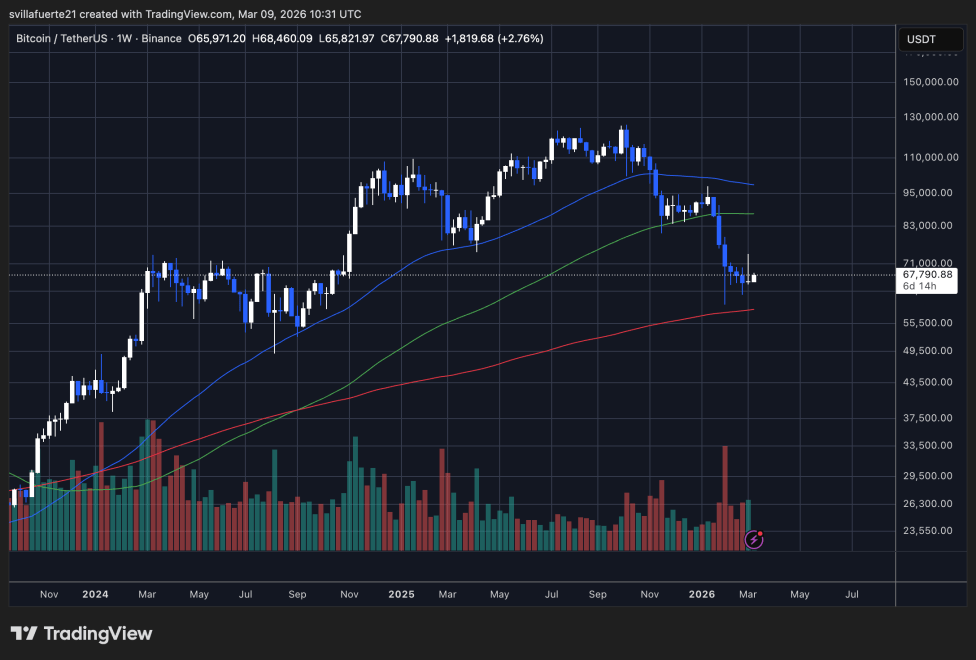
The current price action suggests Bitcoin is attempting to establish a temporary consolidation range around $65,000–$70,000. This zone now acts as an important short-term equilibrium area where buyers and sellers appear to be reassessing market direction after the rapid sell-off.
From a structural perspective, the 100-week moving average (green) remains slightly above the current price and is beginning to flatten, indicating that the broader uptrend is losing momentum. Meanwhile, the 200-week moving average (red), currently positioned near the mid-$50,000 region, continues to slope upward and may represent a critical long-term support if selling pressure intensifies.
Volume activity has increased during the recent decline, suggesting that the correction involved significant distribution. For Bitcoin to regain stronger bullish momentum, price would likely need to reclaim the $70,000–$75,000 region and stabilize above the shorter-term moving averages.
Featured image from ChatGPT, chart from TradingView.com