- December 30, 2025
- Posted by: admin
- Category: BitCoin, Blockchain, Cryptocurrency, Investments
Bitcoin continues to trade below the $90,000 level after multiple failed attempts to break higher since December 14, reinforcing a growing sense of caution across the market. Each rejection near this psychological threshold has added weight to the bearish narrative, with an increasing number of analysts now warning that Bitcoin may be entering a prolonged corrective phase in the year ahead.
Despite this muted price action, on-chain data suggests a more nuanced picture beneath the surface. Top analyst Axel Adler recently shared a chart tracking Bitcoin realized losses using a seven-day moving average and a z-score framework, highlighting a clear transition from November’s extreme capitulation to a period of normalization in December.

This metric measures the volume of losses realized when coins move, with the z-score used to identify stress extremes within the market.
November marked the peak of selling pressure. On November 21–22, the realized loss z-score surged to between 8.7 and 10.9, with daily losses exceeding $5 billion. In comparison, the late-December spike on December 26, which reached a z-score near 1.6, appears relatively minor. More importantly, weekly realized losses have collapsed from roughly $2.4 billion at the peak to around $0.5 billion, returning to levels last seen in September and October.
According to Adler, this sharp decline points to structural seller exhaustion rather than a temporary lull. Historically, markets often stabilize after such conditions, suggesting that while the price remains weak, downside pressure may be fading.
Bitcoin Indicator Signals Fading Downside Pressure
Adler’s report also highlights Bitcoin’s Net Realized Profit/Loss (P/L) metric, smoothed using a seven-day moving average, offering further insight into the market’s internal dynamics. This indicator tracks the balance between realized profits and realized losses over time. When the value is negative, losses dominate and capital is being destroyed; when positive, profit-taking outweighs loss realization.
Currently, Bitcoin’s net realized P/L remains in negative territory, confirming that the market has not fully exited a risk-off regime. However, the direction of travel is notable. Over the final week of December, the depth of negative net P/L shrank by nearly half, signaling a meaningful reduction in loss intensity.

Importantly, this improvement has unfolded without a strong price recovery, suggesting that the change is driven by seller exhaustion rather than an artificial price squeeze or short-term speculation.
According to Adler, this behavior is structurally significant. When net realized P/L trends upward toward the zero line, it reflects a transition phase in which forced selling subsides, and marginal supply weakens. Historically, a sustained move back into positive territory has coincided with the early stages of local market recoveries.
Taken together, the realized loss and net P/L charts present a consistent narrative. November appears to have absorbed the majority of weak hands, December functioned as an absorption and stabilization phase, and January could represent a potential inflection point—provided new demand begins to enter the market.
Price Remains Range-Bounded
Bitcoin remains locked in a tight consolidation below the $90,000 level, as shown on the 4-hour chart, reflecting persistent indecision after repeated failed breakout attempts. Price is currently trading near $87,600, holding within a narrow range that has defined market behavior throughout the second half of December. This structure highlights a balance between buyers defending local support and sellers consistently fading rallies.
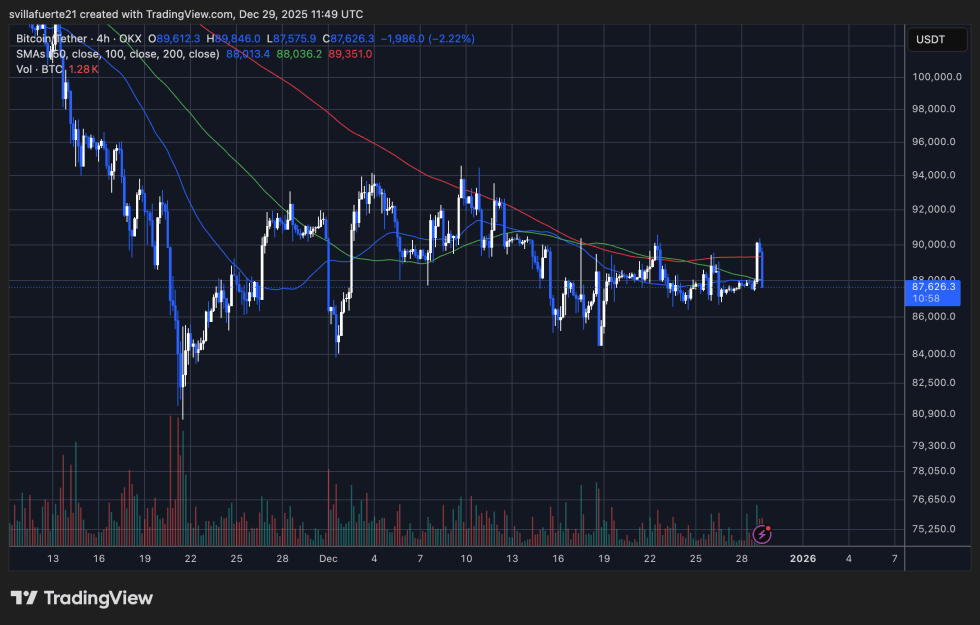
From a technical standpoint, Bitcoin is trading below the declining 200-period moving average, which continues to act as a key dynamic resistance near the $89,000–$90,000 zone. The 100-period moving average has flattened and is closely aligned with price, signaling a lack of momentum in either direction.
Meanwhile, the shorter-term moving average has rolled over, reinforcing the short-term bearish bias and confirming that upside attempts are being absorbed.
The price action since mid-December shows a clear compression pattern, with lower highs forming beneath resistance and higher lows developing above the $86,000–$87,000 support region. This tightening range suggests that volatility is being suppressed, often preceding a decisive move.
Structurally, the $86,000 level remains critical. A clean breakdown below this support could open the door to a deeper retracement toward the low $80,000s. Conversely, reclaiming and holding above $90,000 would invalidate the current bearish structure and signal renewed upside momentum.
Featured image from ChatGPT, chart from TradingView.com