- April 3, 2026
- Posted by: admin
- Category: BitCoin, Blockchain, Cryptocurrency, Investments
Bitcoin is trying to hold $66,000. The market is bracing for volatility. And the on-chain data entering April tells a story of sustained, intensifying pain — with one critical detail that changes how that pain should be interpreted.
Analyst Axel Adler has published on-chain findings that place the current Bitcoin environment in precise historical context. The 7-day moving average of Net Realized Profit and Loss has reached -$410 million as of early April — a deterioration of $154 million in a single week. That acceleration matters as much as the level: loss-selling pressure is not holding steady; it is deepening. Across March and into April, the metric has remained in sustained negative territory, confirming that sellers are consistently exiting positions below their cost basis.

The quarter’s range tells the full story of the reversal. On January 19th, the same metric registered +$394 million — net profit-taking at scale. By February 7th it had collapsed to -$1.99 billion, the deepest single reading of Q1. The current -$410 million represents a re-intensification after a brief stabilization.
The critical detail is the bear market comparison. From October 2025 through March 2026, cumulative realized losses stand at -$64.2 billion — roughly half the -$125.2 billion accumulated during the entire 2021-2022 bear market. The pressure is real. It is not yet existential.
The Behavior Matches the Losses. That Is the Problem.
Adler’s second indicator adds a dimension that the Net Realized P/L metric cannot capture alone. The Short-Term Holder SOPR — measuring the average ratio between the sale price and acquisition price of coins held less than 155 days — has held below 1.0 for nine consecutive days. A reading below 1.0 means short-term holders are selling at a loss. Nine straight days means it is not an episode. It is a regime.

Historically, a prolonged SOPR stress regime of this kind resolves in one of two ways. Either price stabilizes, loss-selling exhausts itself, and the indicator gradually recovers above 1.0 — the pattern associated with bottoming and early recovery. Or price pressure persists, the cohort continues to capitulate, and the market enters a new leg lower. The data does not currently indicate which outcome is forming. It indicates that the stress is active, sustained, and has not yet shown the first sign of resolution.
That first sign has a precise definition. A confident return of the 7-day moving average above 1.0 — and critically, a sustained hold above that level — is the signal Adler identifies as the minimum confirmation that the stress regime is ending rather than pausing.
Taken together, the Net Realized P/L and STH SOPR confirm the same verdict from two different angles. Dollar losses are intensifying. Cohort behavior is systemically loss-driven. The pressure is real and measurable. What it is not — and this distinction matters — is the panic extreme that has historically characterized the final capitulation phase of a bear market. That phase produces readings far more severe than anything visible in the current data.
Bitcoin Consolidates Below Resistance as Bearish Structure Holds
Bitcoin is trading near $66,000 after failing to sustain a recovery above the $70,000 level, reinforcing a broader structure that remains tilted to the downside. The chart shows a clear breakdown in February, followed by a high-volume capitulation event that established the current trading range between approximately $62,000 and $72,000.
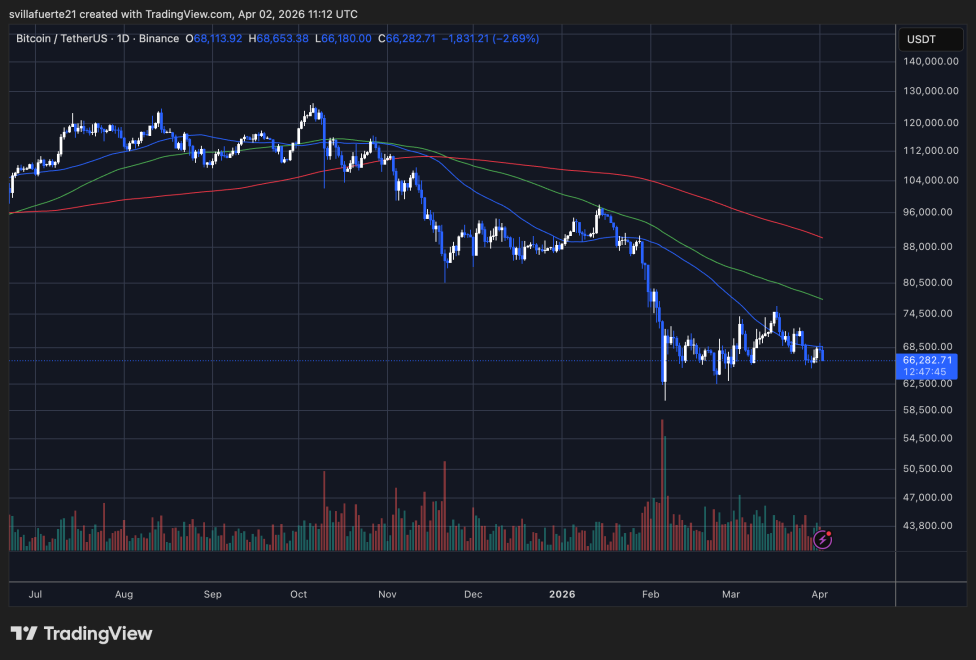
Since then, price action has been defined by consolidation rather than recovery. Bitcoin continues to print lower highs within this range, signaling that sellers are still active on rallies. The 50-day and 100-day moving averages are both trending downward above price, acting as dynamic resistance and capping upward momentum. The 200-day moving average remains significantly higher, confirming that the longer-term trend has weakened.
Volume behavior supports this interpretation. The initial sell-off was accompanied by a sharp spike in volume, suggesting forced liquidations or aggressive distribution. In contrast, the current consolidation phase shows reduced volume, indicating a lack of strong demand to drive a reversal.
Repeated rejections near the upper bound of the range highlight the absence of conviction from buyers. Until Bitcoin can reclaim key moving averages and break above resistance with strength, the structure favors continued consolidation or a potential retest of lower support levels.
Featured image from ChatGPT, chart from TradingView.com